Odda, Norway: Things to Do in Trolltunga's Town and Around the Sørfjord
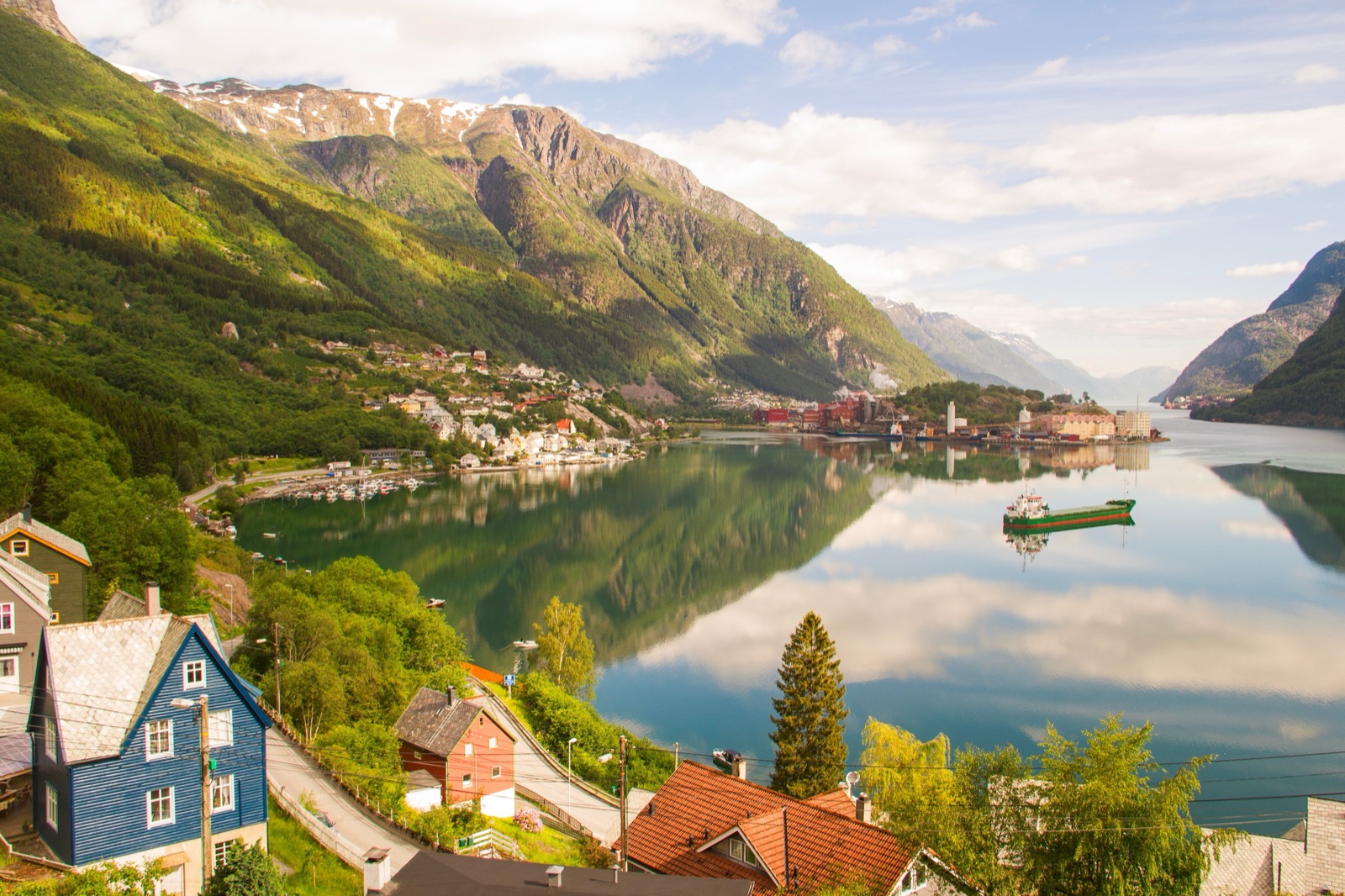
Odda is the town you sleep in before Trolltunga and come back to afterwards. It sits at the head of the Sørfjorden, the long southern arm of the Hardangerfjord, on both sides of the river Opo, which runs from the lake Sandvinvatnet (also spelt Sandvinsvatnet) into the fjord. Store norske leksikon, Norway’s national encyclopedia, counts 4750 inhabitants in 2025, which makes it the largest settlement in Hardanger and the administrative centre of Ullensvang municipality. Tyssedal, where the road to the trailhead begins, is 6 km north on route Rv13.
Odda is a working town rather than a resort. It was a famous tourist destination in the late 19th century, then a smelting town for most of the 20th, and its industrial past is now the thing worth seeing. This guide covers the town itself, the hydropower museum in Tyssedal, the walks and viewpoints, where to stock up for the hike, what to do on a wet day, and the short trips to Låtefoss, the Buarbreen glacier and the orchards of Lofthus. For choosing a hotel, see our article on where to stay near Trolltunga; for the drive and the buses, our guide to getting to Trolltunga.
Odda at a glance
- Where: at the head of the Sørfjorden in Ullensvang municipality, Vestland county.
- Size: 4750 inhabitants on 3 km² in 2025, the largest settlement in Hardanger.
- To Trolltunga: about 30 minutes by car to the trailhead at Skjeggedal, or the summer shuttle bus, which in 2026 ran from 15 May to 27 September.
- Tourist information: at Odda terminal, Smelteverket 33, open Monday to Friday 10am–3pm and closed at weekends.
Where Odda is
Odda lies where the Sørfjorden ends. At the head of the fjord the river Opo links it to Sandvinvatnet, the lake just above the town, and beyond the lake the Odda valley continues south, a valley known for its many waterfalls and high peaks. To the west is Folgefonna, whose Buarbreen glacier arms lie just west of the town.
The town is a trade and service centre for Inner Hardanger and an important transport hub, which is why the buses and the Trolltunga shuttle start here. It has had town status since 2004. Until 2020 it was a municipality of its own; that year it merged with Jondal and Ullensvang to form the new Ullensvang municipality, with Odda as its centre.
For a hiker, that means the shops and the shuttle are in Odda, the trail starts up the valley from Tyssedal, and the waterfalls and the glacier are a short drive south and west.
From tourist resort to smelting town
Odda’s history has two halves. According to Store norske leksikon, tourism started in the late 19th century, when Odda was among the most important tourist destinations in Norway. The scenery around the lake was famous: the landscape in Bridal Procession in Hardanger, the 1848 painting by Adolph Tidemand and Hans Gude, is said to be painted from impressions of Sandvinvatnet near Odda and of the Lustrafjorden. The photographer Knud Knudsen, one of the first professional photographers in Norway, was born in Odda.
Then came the power. Kraftmuseet sums up what happened next: Odda and Tyssedal went from being an important tourist resort to an area of pioneering hydropower and industrial expansion. Construction of the Tyssedal power plant began in September 1906, and in May 1908 it began supplying electricity to the smelting works in Odda. Calcium carbide production started that year under the British company Alby United Carbide Factories, and at start-up the factory was the largest carbide works in the world. In 1909 the North Western Cyanamide Company began making calcium cyanamide, a fertiliser, on the same site. The works shaped the town: Store norske leksikon calls their construction decisive for Odda’s growth, and tourism fell back; only from the 1970s did visitor numbers rise again.
The industry had hard years too. After the First World War both companies stopped work in 1921 and about 1000 workers lost their jobs; production restarted in 1924 under the name Odda Smelteverk. The cornerstone company closed in 2003. In 2009 the industrial heritage of Odda and Tyssedal was placed on Norway’s tentative list for UNESCO World Heritage, together with Rjukan–Notodden, which was inscribed in 2015. The Trolltunga hike runs through the same story: the dam at Skjeggedal, the old funicular to Mågelitopp and the dry riverbed of a waterfall the power stations took. Our article on the Troll Tongue and its history tells that part in detail.
Odda today: industry, books and the smelting works site
Odda is still an industrial town. Its largest industrial company is Boliden Odda, which produces zinc at Eitrheimsneset at the north-western end of the town, though today public administration and services shape the town as much as industry does.
Since the smelting works closed, culture has filled some of the gap. Odda hosts Litteratursymposiet, a literature festival, and much of that literary work is based at Sentralbadet Litteraturhus, a literature house on the old smelting works site. Several Norwegian writers were born in the town.
The smelting works site is also where you find the tourist information office, which has moved to Odda terminal, at the address Smelteverket 33. It is open Monday to Friday 10am–3pm and closed at weekends, so ask your questions on a weekday, and check opening times before you rely on them. It is also the contact for guided tours on the Buarbreen glacier.
Tyssedal and Kraftmuseet
Tyssedal, the village at the mouth of the river Tysso 6 km north of Odda, had 596 inhabitants in 2025. It is where the Trolltunga road turns off, and it holds the museum that explains the landscape.
Kraftmuseet, the Norwegian Museum of Hydropower and Industry, occupies the old Tysso I power station, which ran from 1908 to 1989 and was protected as a technical and industrial heritage site in 2000. The plant was the first high-pressure plant in Northern Europe, with a head of 400 metres. The national hydropower monument, Elektra, was unveiled here in 2000. Store norske leksikon describes the museum as a protected power station that combines hydropower history with concerts, exhibitions and family activities through the year.
Practical details from the museum’s visit page and its Visit Norway listing:
- Where: on the quay in lower Tyssedal. Parking is free for visitors, about 150 metres from the old power station, where the reception is.
- By bus: take bus 990 or 995 from Odda bus station to Tyssedal bus station, then walk 5 minutes down to the museum.
- Prices: NOK 125 for adults and NOK 70 for students; children under 16 go free.
- Opening: Visit Norway’s listing gives every day 10:00–17:00 from 23 May to 30 August, and Tuesday–Friday 10:00–15:00 the rest of the year. The museum’s own pages disagree on the off-season closing time, so check before you go.
- In summer: guided tours start at 11:00, 13:00 and 15:00 and begin with the film The Industrial Adventure. On your own you can explore the turbine hall and the control room, and children get a quiz along the turbines.
For something more active, the museum takes part, with Trolltunga Active, in the Tyssedal via ferrata, a guided climb along the old pipelines with safety gear provided. The museum also runs KraftLaben, a science centre in Odda, where children do experiments on real lab benches from the old smelting works; entry is NOK 60 for one person or NOK 180 for a family. Back in Tyssedal, Tyssedal Hotel, an Art Nouveau building from 1912 built for the hydropower company, holds a collection of original art, is open all year and is known for its cuisine.
Walks and viewpoints
You do not have to climb all day to get a view from Odda. Three walks cover the range:
- Lilletopp, Tyssedal. Kraftmuseet’s own hike above Tyssedal is steep but safe, suitable for all ages, and takes 40–50 minutes to the top, with a view over the fjord and the Folgefonna glacier. It is accessible all year. From the P1 car park at Tyssohallen you follow the toll road for 1 kilometre, then the path up the mountainside; a museum ticket gives 3 hours of free parking. It makes a good leg-stretcher the day before Trolltunga.
- Mt Rossnos. The serious one: a summit hike with views over Odda, the Folgefonna glacier and the fjord. Follow route 13 towards Tyssedal; 300 metres after the bridge over the Opo, turn first right, then first left up Freimsvegen; the trail starts at the end of the road. Park in the centre of Odda. Visit Hardangerfjord lists it at 4 km one way with 1,200 metres of total ascent and about 6 hours of walking, in a season from June to October. It is very steep up to Freimsstølen, and there are steep cliffs. On a rest day between hikes, it is not a rest.
- The Buer valley. A 3 km walk one way up a glacial valley towards Buarbreen, described below.
Down at lake level, Trolltunga Camping beside Sandvinvatnet has a new dock for swimming and rents canoes and SUP boards, which is the gentlest way to spend a sunny afternoon after a long hike.
Food, shops and gear before the hike
Odda is the place to stock up. It is the trade and service centre for the inner fjord, and Visit Hardangerfjord’s listing for Hardanger Hotel, in the centre, puts it within walking distance of the bus station, shops and restaurants. Trolltunga AS adds that there are several sports stores in Odda, useful if your boots, waterproofs or headlamp are not up to the mountain.
What to buy depends on the hike, but the destination company’s advice is to eat about every two hours on the trail, so pack for a full day. Visit Norway suggests a 30-litre backpack for the day. You can fill water bottles at the P2 car park in Skjeggedal, but bring all your food from town.
A few other things are easier to sort out in Odda than at the trailhead:
- Gear rental. Rain jackets and trousers, hiking boots and backpacks can be rented from Trolltunga Active at its base in Skjeggedal.
- Charging. There are no EV charging points at the car parks, so charge in Odda.
- Taxis. Odda Taxi takes bookings between 6am and midnight, and a 5am ride has to be booked the day before.
- Dinner. Trolltunga Hotel, in a 1928 villa in Odda, has a restaurant serving an à la carte menu based on local produce, and Tyssedal Hotel is known for its cuisine.
Buy your hiking food the evening before. On the 2026 timetable the first morning shuttle reached P2 Skjeggedal at 06:15, which leaves no time to shop in the morning.
Rainy-day options
Odda gets plenty of rain, and Trolltunga AS’s rule is never to hike in strong wind, heavy rain or fog. Visit Norway recommends allowing at least two days in the area for that reason. So the chance that you spend a day in Odda waiting for the weather is high. The options:
- Kraftmuseet. The obvious indoor choice: the old power station, the film and the story of the valley, a short bus ride north in Tyssedal.
- KraftLaben. The science centre in Odda, if you are travelling with children.
- Låtefoss. It stands right beside the main road, so it is a short stop even in poor weather.
- A long lunch. The hotel restaurants in Odda and Tyssedal, and the art collection at Tyssedal Hotel.
- A drive up the fjord. Follow the Sørfjorden north to the orchards of Lofthus.
Låtefoss and the Odda valley
Låtefossen is the main sight of the Odda valley, often called the “Valley of Waterfalls”. It is a twin waterfall with a total drop of about 165 metres, right next to National Road 13, around 15 minutes’ drive from Odda. The water gathers beneath a stone arch bridge built between 1857 and 1859, when tourists were brought out from Odda by horse and carriage to see the falls, and widened in the mid-1940s.
Two practical points. The parking area is small, and on the most popular summer days there can be queues for it, so be considerate of traffic on the narrow bridge. And about 50–60 metres south of the bridge, an old chaussée road climbs the eastern side of the valley to a viewpoint above the falls and the ruins of the old viewing café. Our article on Låtefoss covers the waterfall in full.
Buer and the Buarbreen glacier
Buarbreen is the name of two glacier arms on the east side of Folgefonna’s southern and largest part, west of Odda. It used to be one arm; as the glacier has retreated, it has split into an upper and a lower glacier.
The walk towards it starts in the Buer valley. Turn off route 13 where it is signposted Buer and drive to the end of the road, where there is parking by the National Park Farm at Buer, with campervans welcome, for NOK 185. The trail is 3 km one way, with 600 metres of total ascent and a total walking time of 4 hours, and its season in an average year runs from the end of May to October. It follows the river for most of the way, with bridges in places and ropes on some of the climbs; the last part is in steep terrain, and sturdy hiking boots are necessary. From Trolltunga Camping it is 5 km to Buer.
The rule at the top is short: do not go near the glacier. It is in constant movement, and going near it can be very dangerous. For a guided walk on the ice itself, contact the tourist information in Odda. Our article on Folgefonna and Buarbreen has more on the glacier and the guided options.
Lofthus and the Sørfjord orchards
North of Tyssedal, the east shore of the Sørfjorden turns into fruit country. Lofthus is in Norway’s largest fruit-growing area, and the blossom lasts from about mid-May to mid-June. Its landmark is Hotel Ullensvang on the fjord shore, with Edvard Grieg’s original composer’s hut in the garden. Fjord Tours calls Lofthus an ideal base for hikes and puts the start of the Trolltunga hike about 30 minutes away by car. Our article on the Hardangerfjord covers the wider fjord, and our where-to-stay article compares Lofthus as a base.
Getting to Odda
By car, Odda is about 3 hours from Bergen, 2.5 hours from Haugesund, 4 hours from Stavanger and 6 hours from Oslo. Without a car there are buses from Bergen and Voss, bus connections from the railway stations in both, a year-round speedboat from Bergen to Rosendal with connecting buses on route 760, and from Oslo the Haukeliekspressen express bus with a change at Seljestad. Our guide to getting to Trolltunga has the details and the trailhead logistics.
Fitting Odda around the hike
The hike decides the shape of your stay. From P2 Skjeggedal the round trip is 27 km and takes 8–12 hours; from P3 Mågelitopp it is 20 km and 7–10 hours. The shuttle from Odda to P2 takes about 30 minutes, and on the 2026 timetable buses back to Odda left P2 at 13:15, 15:00, 16:30, 18:00 and 19:15. The shuttle stops near Hardanger Hotel, in the centre.
A sensible three-day plan:
- Day one: arrive. Drive or bus in from Bergen, walk the town, visit the tourist information if it is a weekday, and buy food for the hike.
- Day two: Trolltunga. An early shuttle to Skjeggedal, or a guided hike that meets at P2. Back in Odda in the evening for dinner.
- Day three: rest or reserve. If the weather spoiled day two, this is your hike day. If not, take it easy: Kraftmuseet and Lilletopp in Tyssedal, or Låtefoss and the Buer valley, or the drive north to Lofthus.
If you would rather not organise the shuttle and the timing yourself, a guided day hike takes most of that off your hands; the tours page lists the current options.
Frequently asked questions
How far is Odda from Trolltunga?
Tyssedal, where the road to the trailhead turns off, is 6 km north of Odda on route Rv13. By car it takes about 30 minutes from Odda to Skjeggedal, the main trailhead, and in summer a shuttle bus runs the same route. The hike itself is 27 km return from there.
What is Odda known for?
Its industrial past and its setting. Odda was one of Norway’s leading tourist destinations in the late 19th century, then grew as a smelting town powered by the hydropower plant in Tyssedal. Odda Smelteverk closed in 2003, and the industrial heritage of Odda and Tyssedal is on Norway’s tentative list for UNESCO World Heritage.
What can you do in Odda when it rains?
Visit Kraftmuseet in Tyssedal, the national museum of hydropower and industry, or its KraftLaben science centre in Odda. Låtefoss, beside the main road south of town, is a short stop in any weather.
Is there a glacier near Odda?
Yes. Buarbreen, an arm of the Folgefonna glacier, lies west of the town. A 3 km trail one way leads up the Buer valley towards it, but do not go near the glacier itself: guided glacier walks are arranged through the tourist information in Odda.
Where is the tourist information in Odda?
At Odda terminal, Smelteverket 33. It is open Monday to Friday 10am–3pm and closed at weekends; check the hours before you go.
How do I get to Odda from Bergen?
By car it takes about 3 hours. By public transport there are buses from Bergen, and a year-round speedboat from Bergen to Rosendal with connecting buses on route 760.