What to Wear and Pack for Trolltunga: A Layer-by-Layer Packing List
For Trolltunga, wear wool next to the skin, carry an insulating middle layer and a waterproof, windproof jacket and trousers, and walk in sturdy hiking boots. Pack plenty of food (eat about every two hours), at least 1.5 litres of water to start with, a headlamp, sunglasses and high-factor sunscreen, a hat and gloves, a small first aid kit and a charged phone. That is the short version, and it applies on a hot July morning as much as in September: Trolltunga AS, the company owned by Ullensvang Municipality that runs the trail, warns that the weather can change quickly even on sunny days, and that it is always colder up in the mountains than down by the fjord.
The longer version matters because the hike is long. From P2 Skjeggedal the round trip is 27 km and takes 8–12 hours; from P3 Mågelitopp it is 20 km and 7–10 hours. Whatever you carry, you carry all day, and whatever you leave behind you will not find on the mountain. Below is a layer-by-layer list, what changes early and late in the season, what to leave in the car, and where to rent what you do not own.
The packing list at a glance
| Item | Why | Notes |
|---|---|---|
| Wool base layer | Keeps you warm when wet with sweat or rain | No cotton |
| Mid layer | Warmth on breaks and on the plateau | Wool jumper, fleece or synthetic jacket |
| Waterproof, windproof jacket | Wind and rain on an exposed plateau | Trolltunga AS calls it a must |
| Waterproof over-trousers | Rain and cold wind | Essential if rain is forecast |
| Sturdy hiking boots | Rock, marsh, mud and late snow | Worn in before the trip |
| Spare socks | Wet feet are cold feet | Wool |
| Hat and gloves | The plateau is colder than the valley | Even in summer |
| Sunglasses, sunscreen, cap | Sun on snow and bare rock | High SPF |
| Food | Energy for a long day | Eat about every two hours |
| Water | 1.5 litres to start | Refill only above Floren |
| Headlamp | The descent is the long part | Plus spare batteries |
| First aid kit, phone | Help yourself and others | 112 for emergencies |
| Rubbish bag | Everything comes back down | Used toilet paper included |
Why the weather decides what you carry
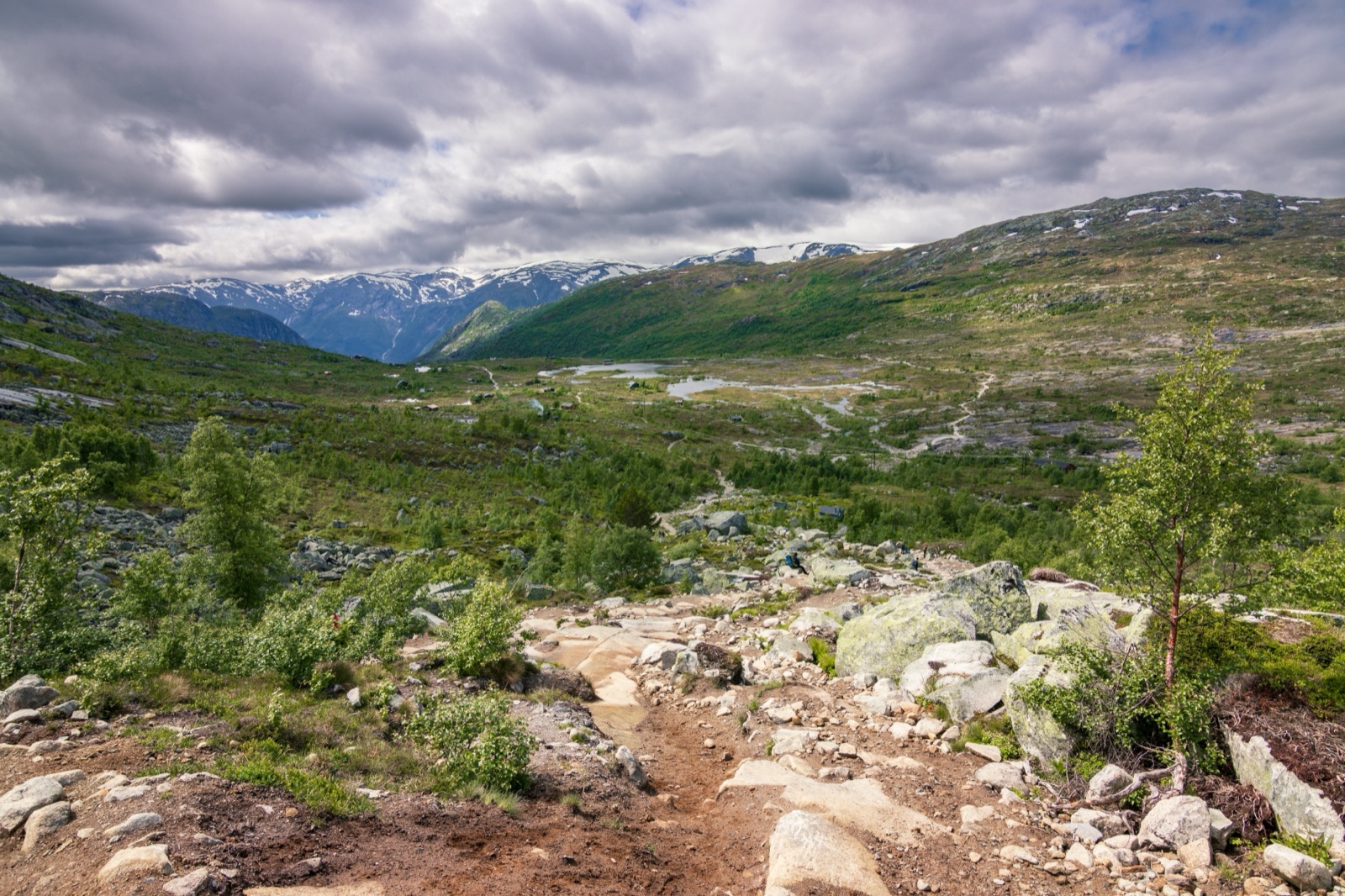
Most of the hike is on a high plateau. Once you are past the steep climbs, at around 900 metres, the trail stays high, open and exposed all the way to the ledge at 1,180 metres. There is no tree cover and no village to duck into. Trolltunga AS puts it simply: never hike if there is a strong wind, heavy rain or fog, and always check the forecast before you start.
Trolltunga Active, one of the two guiding companies at the trailhead, describes what this means for clothing. You might start in summer temperatures in the valley and climb to big patches of snow on the mountain. Temperature can deceive, because the wind plays an important role in how cold it feels. On rainy days, low temperatures and cold wind make the hike hard even in summer, and on a sunny day you are very exposed, so you have to plan for hours in the sun and keep drinking. Their rule of thumb is to prepare for the worst conditions without overloading the backpack, because weight matters greatly when it comes to saving energy.
For the month-by-month picture, see the Trolltunga weather guide. For this page, the point is that a good forecast is not a reason to leave the jacket in the car.
The base layer: wool, not cotton
The layer against your skin does most of the work. Trolltunga AS recommends wool all year round, for a practical reason: wool warms when it is cold and has a cooling effect in the heat, and if you get wet it keeps you warm. Its advice for the inner layer is a thin, insulating top, preferably wool, because wool insulates well even when it gets wet and sweaty.
Cotton is the thing to avoid. Trolltunga AS notes that cotton loses all its insulating ability as soon as it gets wet, and on a climb like Gryteskaret you will sweat whatever the weather. Trolltunga Active’s lists say the same in bold: do not use cotton, because it is freezing cold when it is wet. A cotton T-shirt that is soaked at the top of the first climb will chill you on every break for the rest of the day.
- Top: a thin merino or other wool long-sleeve. Synthetic sports tops dry fast too, but wool is the operator’s first choice.
- Legs: hiking trousers that dry quickly; wool leggings underneath early or late in the season.
- Socks: wool hiking socks, and a spare pair in a plastic bag.
The middle layer: warmth for breaks
The middle layer is the one you put on when you stop. On the plateau, a lunch break in the wind cools you down within minutes, and the photo queue at the ledge can mean standing around for 30–45 minutes on a weekday at midday in high season.
Trolltunga AS lists the options: a wool sweater, down jacket, fleece or PrimaLoft jacket. It adds one useful distinction. A PrimaLoft (synthetic) jacket insulates even when it gets wet, while a down jacket loses its insulating ability when wet. On a day with showers forecast, synthetic is the safer choice; on a dry, cold day down is lighter for its warmth.
The outer layer: waterproof and windproof
Trolltunga AS calls waterproof and windproof outerwear a must, because the mountain winds can get quite cold. That means a proper shell jacket with a hood, not a light showerproof windbreaker, and waterproof over-trousers if any rain is forecast. Trolltunga Active puts wind- and waterproof shell trousers on its list for any day with rain and low temperatures.
The trick with a shell is not to sweat inside it. Trolltunga AS suggests opening the air vents in the jacket or taking off the middle layer before you start a climb. Put layers on when you stop, take them off before you go uphill, and you will stay drier all day.
Boots and feet
Footwear is the item people most often get wrong. The trail is well maintained and clearly marked, but it is rock, gravel, steps and marsh. Visit Norway notes that you cross wet marsh, mud and water in several places, and Trolltunga AS recommends sturdy hiking boots because even towards the end of June there may still be snow on the mountain in some years.
- Boots, not trainers. Ankle support helps: the most common injury on the trail is a sprained ankle.
- Worn in. A 20 km or 27 km day is not the place to break in new boots.
- Waterproof if you can, for the marsh sections and late snow.
- Blister kit: plasters or tape, put on at the first hot spot.
If you have troublesome knees, think hard before you go. Trolltunga Active says its guided hike is not suitable for people with troublesome knees, and the long descent is where knees complain. Walking poles help on the way down; the guided tours include them.
Food: more than you think
Trolltunga AS advises eating about every two hours in the mountains and warns that you are more prone to accidents when you are tired and lose concentration. A ten-hour day burns far more energy than a normal one, and there is nowhere on the mountain to buy anything.
- Lunch: two substantial sandwiches or wraps, more than you would eat at home.
- Snacks: nuts, chocolate, fruit, energy bars. Trolltunga AS suggests energising snacks such as chocolate and fruit.
- Something salty for long, hot days.
- A treat for the ledge. The wait for the photo is a good time for lunch.
Trolltunga Active’s summer list is simple: a lot of food, such as sandwiches, nuts, chocolate and a banana. For winter it asks for at least double what you would eat on a normal day.
Water: how much to carry and where to refill
Trolltunga Active asks summer day hikers to bring 1.5 litres of water, which can be topped up at some spots along the trail. Trolltunga AS adds where, and where not:
- Fill up at P2 Skjeggedal, by the car park, before you start.
- Do not fill up near the cabin areas. That water is not safe to drink.
- Wait until the first emergency shelter just before Floren, about halfway to Trolltunga, before taking water from streams.
- Avoid filling up near Trolltunga itself.
- Prefer running streams to lakes, and be careful after heavy rain, when water may carry many impurities.
The water in the wilderness is not tested, so Trolltunga AS cannot guarantee that it is safe. Many hikers drink it; some carry a filter or purification tablets. Either way, the Norwegian Mountain Code makes the point that during exertion your body needs more fluid than you feel thirsty for, so drink before you are thirsty. On a hot, clear day, 1.5 litres between refills is a minimum, not a target.
Sun protection
It feels odd to pack sunscreen for a mountain where people get rescued for cold, but both apply. Trolltunga AS warns that even if the wind is cool you can get sunburned without noticing it until it is too late, and asks you to cover your skin and use high-factor sunscreen. With snow lying well into June, it also tells you to bring sunglasses and high SPF sunscreen. A cap or hat with a brim, sunglasses and a small tube of sunscreen weigh almost nothing.
Headlamp and the descent
A headlamp is on every list for a reason. Trolltunga AS says that for safety you should bring one, because the descent can be challenging, especially when you are tired. Many accidents happen on the way down, when hikers are tired, and in September the sun sets at Odda at 20:37 on the 1st and 19:09 on the 30th. A late start, a long queue and a slow descent can put you on the last climb down in the dusk.
Bring a headlamp with fresh batteries, and spares; the Norwegian Mountain Code reminds you that GPS and other electronic aids are useful, but only with spare batteries. Your phone torch is not a substitute, because you need the phone for the map and, if it comes to that, for 112.
Safety kit
None of this is heavy, and all of it earns its place on a long day:
- First aid kit with plasters, blister tape, a bandage and painkillers. The Mountain Code asks you to bring one so you can help yourself and others.
- Phone, fully charged, plus a small power bank. Store the emergency numbers: 112 police, 113 medical, 110 fire.
- The trail map, downloaded. Trolltunga AS’s map shows the nearest emergency shelter, the recommended camping spots and the places with running water.
- Something bright: the Mountain Code suggests a reflective vest or headlamp to help rescuers find you.
- A rubbish bag. Small rubbish bags are available from the shuttle bus driver, and everything you carry up comes back down, used toilet paper included. There are no toilets on the mountain.
The backpack
Trolltunga Active suggests a backpack of about 35 litres for the summer day hike, and at least 40 litres for an overnight, when you also carry a sleeping bag liner, warm evening clothes and dinner. A pack with a hip belt carries a day’s load better than a shoulder bag. Line it with a bin bag or use a rain cover: a soaked spare layer is no spare at all.
Early and late in the season: spikes and extra warmth
From June 1st to September 30th experienced hikers can walk on their own; Trolltunga AS recommends a guided hike for the rest of the year. Even inside the summer window, the edges of the season need more:
- Micro spikes. Trolltunga Active asks hikers early and late in the season to leave space in the backpack for micro spikes and to make sure snowshoes can be strapped on. On a guided tour the spikes or snowshoes are provided if needed.
- Warmer layers. Snow can settle as early as mid-October, and snow showers may come earlier. Add a warm hat, a second pair of gloves and a warmer mid layer.
- Rain kit, always. If rain and low temperatures are forecast, Trolltunga Active adds a wool base layer, a warm mid layer, waterproof over-trousers, spare socks, a beanie and gloves.
For a winter or spring hike the list changes again; see Trolltunga in winter.
What to leave behind
Weight is energy. Things that do not need to come:
- Cotton jeans and hoodies. Heavy when wet, cold when wet.
- A big camera bag, unless photography is the point of the day. A phone takes the classic shot.
- A drone, unless you know the rules and the crowd allows it. Trolltunga AS strongly advises against drones; see the Trolltunga photo guide.
- Stickers. Trolltunga AS asks you never to stick them on signs or information boards.
- Glass bottles and anything you are not willing to carry back down.
If you are camping
A night on the mountain adds a tent, a warm sleeping bag, a thick mat and a stove, and a much heavier pack. Trolltunga AS calls a good thick sleeping mat an absolute must, because a lot of body heat is lost through the ground, and warns that strong winds can easily tear apart cheap tents. Open fires are banned from 15 April to 15 September. The full list, and where you may pitch, is in the Trolltunga camping guide.
Renting gear in Skjeggedal and Odda
If you are travelling light, you do not need to buy everything. Trolltunga AS says hiking equipment can be rented from Trolltunga Active in Skjeggedal, and that there are several sports stores in Odda. Trolltunga Active lists rain jackets and trousers, hiking boots and backpacks as rentable on site. Rent the day before rather than the morning of the hike, so you can try boots on and adjust a pack.
The guided tours include part of the kit. Trolltunga Active’s summer hike comes with walking poles and, if needed, micro spikes or snowshoes; its overnight includes a warm sleeping bag and liner. A guide also checks your clothing at the start, which is a good safety net if you are unsure. You can compare the options on the tours page, and the guided tours guide explains how they differ.
Before you leave the car: a last check
Trolltunga’s parking attendants and Mountain Rangers check that hikers are properly dressed and carry enough food and water, and that has prevented many injuries. Run the same check yourself at P2 or P3:
- Forecast checked: no strong wind, heavy rain or fog.
- Wool on, cotton off. Shell jacket and trousers packed.
- Food for the whole day, plus extra. Water bottle full.
- Headlamp, first aid kit, phone charged, map downloaded.
- Hat, gloves, sunglasses, sunscreen.
- Someone knows your plan and when you expect to be back.
- You know the last shuttle time down from P3 (see getting to Trolltunga).
Frequently asked questions
What should I wear to hike Trolltunga?
A wool base layer, an insulating mid layer, and a waterproof, windproof jacket and trousers over the top, with sturdy, worn-in hiking boots and wool socks. Trolltunga AS recommends wool all year round and says waterproof and windproof outerwear is a must.
Can I hike Trolltunga in trainers?
It is not recommended. The trail crosses rock, marsh, mud and water, and snow can lie into late June. Trolltunga AS recommends sturdy hiking boots, and the most common injury on the trail is a sprained ankle.
How much water should I bring for Trolltunga?
Start with at least 1.5 litres, filled at P2 Skjeggedal, and refill from running streams after the first emergency shelter near Floren. Do not drink water near the cabin areas, and drink more on hot days.
Can I rent hiking gear for Trolltunga?
Yes. Trolltunga Active in Skjeggedal rents rain jackets and trousers, hiking boots and backpacks, and there are several sports stores in Odda.
Do I need a headlamp for Trolltunga?
Yes. Trolltunga AS asks every hiker to bring one, because the descent can be challenging when you are tired, and the days shorten quickly after August.