Trolltunga Photos: Beating the Queue, Sunset Light and the Drone Rules
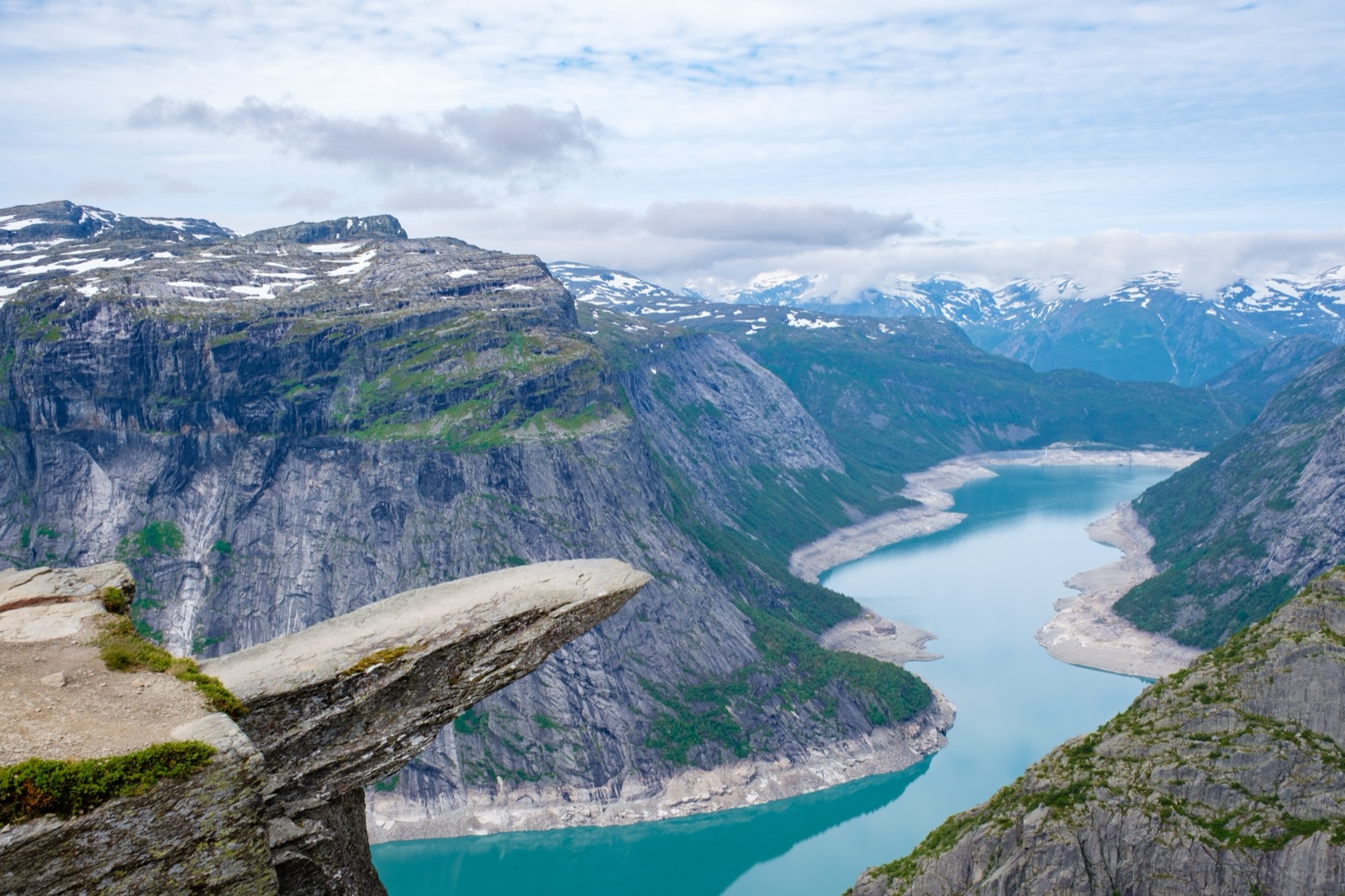
The classic Trolltunga photo is a person standing out on the tongue of rock, 700 metres above the lake, shot from the side by someone on the cliff behind. To get it without a long wait, arrive before about 12:00 or after about 15:00, avoid Saturdays and the first sunny day after a spell of rain, and visit outside the peak weeks from about 20 June to 20 August. At midday in high season expect to queue 30–45 minutes on a weekday and 60–90 minutes on a Saturday. For the best light, stay for sunset, which means either a fast walk out in the evening or a night on the mountain; sunrise is less useful, because the sun rises behind the mountain and you cannot photograph the ledge with it.
This guide covers the queue and how it works, where to stand for the shot, what the light does through the day and the year, the photos only guided groups can take, and what Norway’s drone rules mean for visitors.
The short answer
- The shot: taken from the cliff beside and behind the tongue, looking out along it over Ringedalsvatnet.
- The queue: busiest from 12:00 to 15:00, from about 20 June to 20 August. Shortest early in the morning and late in the afternoon.
- The light: sunsets can be magical in good weather; sunrise comes from behind the mountain.
- The fear of heights fix: stand on the cliff with the empty tongue behind you.
- Drones: Trolltunga AS strongly advises against them, and Norwegian rules apply if you fly.
How the photo queue works
Everyone who walks 10 km out wants the same picture, and the tongue takes one person or one small group at a time. So there is a queue. Trolltunga AS’s figures:
| When | Expected wait |
|---|---|
| Weekday, around midday, high season | 30–45 minutes |
| Saturday, high season | 60–90 minutes |
| Early morning or late afternoon | Little or none |
The peak runs from about 20 June to 20 August, and in July and August the busiest hours are 12:00 to 15:00, when most people reach the rock. The most crowded days are Saturdays and the first sunny day after several days of rain, when everyone who has been waiting for the weather goes at once.
In season a Mountain Ranger walks out to the ledge around midday to organise the queue, unless needed for a rescue. Trolltunga AS suggests using the wait for your packed lunch and a chat. It is a good time to eat: the packing list has what to bring.
Queue etiquette
When it is your turn, keep it short. Trolltunga AS asks people to limit themselves to just a few poses. A sensible routine:
- Agree the shots before you go down. Who stands where, which poses, which camera.
- Hand your phone to the next person in line if you are alone. Someone nearby will usually be happy to take your picture, and you can return the favour.
- Climb down and back with care. Four iron rebar steps make it easy to get onto the tongue. Do not rush them.
- No stunts. No jumping, no sitting with legs over the far edge, no backflips. Trolltunga AS asks everyone to keep a safe distance from the edge, and a fall would be fatal.
The viral photos of people hanging off the tip or doing handstands on it are, as Wikipedia notes, most often manipulated. One well-known image of a climber hanging below the tongue was taken with a safety harness, and the rope was later erased.
Where to stand for the classic shot
The shot everyone recognises is taken from the cliff to the side of the tongue, slightly above it, so that the rock juts out into empty air with the lake and mountains beyond. Your photographer stands on the main cliff; you walk out onto the tongue.
- Wide lens or phone main camera. The scene is big; the person is small. That is the point.
- Landscape and portrait. Landscape shows the length of the lake; portrait shows the height of the drop.
- Include the far shore. Ringedalsvatnet, the steep grey walls of Ringedalen and, on a clear day, the Folgefonna glacier in the distance give the picture its scale.
- Expose for the sky. On a bright day the lake and cliffs can go dark; tap on the brightest part of the scene, or bracket.
If you are afraid of heights
You do not have to stand on the tongue at all. Trolltunga AS suggests an easy alternative: have someone take a picture of you on the cliff, with Trolltunga in the background. The perfect moment, it says, is when someone has just climbed back up and left the tongue empty. Some of the pictures on its own site were taken that way. It is also a good way to photograph the ledge itself without the queue on it.
The light through the day
The tongue points out over the lake, and the light changes the picture completely.
- Morning: the sun rises behind the mountain. Trolltunga AS is clear that you cannot capture a photo of the ledge with the sunrise. Early light is still good for an empty ledge and soft colour on the far side of the valley, and there is little or no queue.
- Midday: the busiest time and the harshest light. Hard shadows, bright rock, a deep blue lake.
- Late afternoon and evening: the crowd thins as hikers head down, and the light warms. Trolltunga AS calls sunset a wonderful time to take photographs, and in autumn recommends the sunset towards Folgefonna.
The catch is getting back. A sunset at the ledge means a descent in darkness, unless you camp or join an overnight trip.
Sunset and sunrise times
Daylight at Trolltunga varies from almost 19 hours in summer to less than 6 hours in winter. Trolltunga AS points to the timeanddate sun graph for exact times. These are timeanddate’s 2026 times for Odda, in the valley below; on the plateau, with mountains all around, the moment the sun disappears will not match the valley time exactly.
| Date (Odda) | Sunrise | Sunset |
|---|---|---|
| 1 September | 06:28 | 20:37 |
| 15 September | 07:01 | 19:55 |
| 30 September | 07:36 | 19:09 |
| 15 October | 08:13 | 18:24 |
| 31 October | 07:53 | 16:40 |
In high summer the sun sets so late that a sunset at the ledge is only realistic with a night on the mountain. In September the times are kinder, the queue is gone and the colours on the plateau start to turn. Autumn on the mountain, Trolltunga AS says, glows red, yellow and orange. But the days shorten fast, so leave a wide margin and bring a headlamp. For the month-by-month weather, see the weather guide.
A night on the mountain for the light
The easiest way to photograph Trolltunga at sunset, and to have it almost to yourself, is to sleep near it. Recommended camping spots are marked on the Trolltunga AS map; bring proper equipment, because it can get cold at night. The rules, from where you may pitch to the fire ban, are in the Trolltunga camping guide.
The guided alternative carries less. Trolltunga Active’s sunset-sunrise trip walks out in the afternoon to a dome camp about 3 km before Trolltunga, leaves the packs there and continues to the ledge, where, the company says, most hikers are already heading down, so you see it without the crowds. Its summer version is a 28-hour trip from NOK 4,400. There are three Arctic Dome tents, each for a maximum of 6 people, and the group is usually back between 2 pm and 3 pm on the second day. You can compare it with the other overnights on the tours page.
The needle view and other guided shots
Some photos are not possible on your own. Trolltunga Active offers its guided hikers what it calls the “needle” view of Trolltunga, a shot from below the rim that needs a rope, only on guided tours and only when the weather conditions allow rappelling down. The guides also help with taking photos all day and, the company says, know the best photo spots.
The via ferrata gives a different perspective again: you climb the 250-metre route up the rock face before hiking the final 3 km to Trolltunga, so the day includes a view of the cliffs from a route most hikers never see. The guided tours guide explains how each trip works.
Photo spots on the way
The ledge is the end, not the only view. On the Trolltunga hike:
- The top of Gryteskaret. After the first steep climb the view opens up, and there is a five-metre-high boulder at the pass that almost disappears under snow in winter.
- Store Floren. The first big view down to Ringedalsvatnet, far below. Trolltunga AS calls it the perfect place for a break.
- The plateau lakes. Small lakes, snow patches into June and wide skies.
- Tyssehøl. The dry riverbed that once fed Tyssestrengene, the twin waterfall that was Norway’s highest at 646 metres before its water was diverted in 1967.
- The final approach. The moment the tongue comes into view along the cliff. Watch your footing here: the trail narrows near the high drop.
Photos through the seasons
The same rock looks like a different place through the year, and each season has its own trade-off.
- June: long, bright days and snow still lying on the plateau in some years, which makes for strong contrast against the dark rock and the blue lake. The queue starts to build from about 20 June.
- July and August: the greenest landscape and the warmest days, but the busiest ledge. Go early or late, and expect company in every shot.
- September: quieter, with autumn colour starting and sunsets at a time you can still walk to. The best month for many photographers, if the weather plays along.
- October onwards: snow can settle from mid-October, and Trolltunga AS recommends a guide from October to May. Trolltunga in its winter coat is, in its words, an experience of a lifetime, and the mountain is almost uncrowded. On icy days, though, guides may decide it is not safe to walk out onto the tongue and will find another viewpoint instead. See Trolltunga in winter.
Weather, fog and the wasted walk
The hardest thing about Trolltunga photography is that you cannot see the forecast from the car park. Low cloud can sit on the plateau while Odda is clear, and a day of fog means a 20 km walk to a white wall. Trolltunga AS’s rule is never to hike in strong wind, heavy rain or fog, and it applies to photographers as much as anyone. Check the forecast the evening before and again in the morning, follow the Trolltunga Trail Information page for conditions on the trail, and keep a spare day in your plan if the picture matters to you. The first clear day after rain is beautiful, but it is also the busiest.
Drones: what Trolltunga AS asks
Trolltunga AS strongly advises against the use of drones. If you fly anyway, its photo page sets out the conditions: follow the regulatory framework, never put anyone at risk, register as a drone pilot, and show consideration for other hikers. In particular, for their safety it asks you not to fly when there are many people on Trolltunga itself, which in summer means most of the day.
The practical reasons are obvious on site. The ledge is small and crowded, the air above the cliff is gusty, and a drone that falls goes 700 metres.
Drones: Norway’s rules for visitors
The Civil Aviation Authority of Norway (Luftfartstilsynet) sets out the rules for visiting pilots. In short, you may generally fly in the open category if you are registered as an operator. Before you go:
- Register. EU citizens registered as operators in their home country do not need to register again in Norway. Citizens of other countries must register in an EU country or in Norway, at flydrone.no.
- Hold the right certificate for the subcategory you fly in.
- Mark the drone with your operator number.
- Register camera use. Before flying with a camera or other sensors, you must register the use of photos, video and other sensors with the Norwegian National Security Authority.
- Insure it. Liability insurance is required, except for drones under 250 grams in the open category.
- Check the zones on the map at dronesoner.no before take-off.
In the air, the open-category rules apply: drones under 25 kg, within visual line of sight, no flying over assemblies of people, and no higher than 120 metres from the closest point of the earth. That last rule matters at a cliff. Luftfartstilsynet’s limit is a maximum of 120 metres from the nearest point of the earth, not from where you took off, so a drone flown out over a 700-metre drop can be far above the permitted height even if it is level with your feet. Night flying needs a green flashing light under the drone.
Practical photo kit
- Phone or compact camera for the classic shot; a light wide-angle lens if you carry a camera.
- A power bank. Cold drains batteries, and you need the phone for the map and emergencies too.
- A rain cover or zip bag for the camera.
- Lens cloth. Spray and drizzle are common.
- Headlamp for any sunset plan. Trolltunga AS says to bring one for safety, because the descent can be challenging when you are tired.
- Leave the tripod unless you are camping; it is extra weight on a 20–27 km day, and there is no room for it in the queue.
Respecting the place
The best photos come from a trail that is still in good shape. Stay on the path to avoid erosion, because the alpine vegetation is exceptionally fragile; carry all rubbish out; never fix stickers to signs or information boards; and keep the ledge moving for the people behind you. It is a long walk for everyone.
Frequently asked questions
When is the best time to photograph Trolltunga?
Early morning or late afternoon, when the queue is short and the light is softer, and ideally outside the peak weeks from about 20 June to 20 August. For sunset light, camp or join an overnight trip.
How long is the queue for the Trolltunga photo?
At midday in high season, about 30–45 minutes on weekdays and 60–90 minutes on Saturdays. Early or late in the day there is usually little or no queue.
Can you see the sunrise from Trolltunga?
You can see it, but you cannot photograph the ledge with it: the sun rises behind the mountain. Sunsets are the better time for photos when the weather is good.
Can I fly a drone at Trolltunga?
Trolltunga AS strongly advises against it. If you fly, you must be registered, follow the open-category rules and register camera use, and Trolltunga AS asks you not to fly when there are many people on the ledge.
Where is the classic Trolltunga photo taken from?
From the cliff beside and slightly above the tongue. Your photographer stays on the main cliff while you walk out onto the rock, with the lake and the mountains behind you.