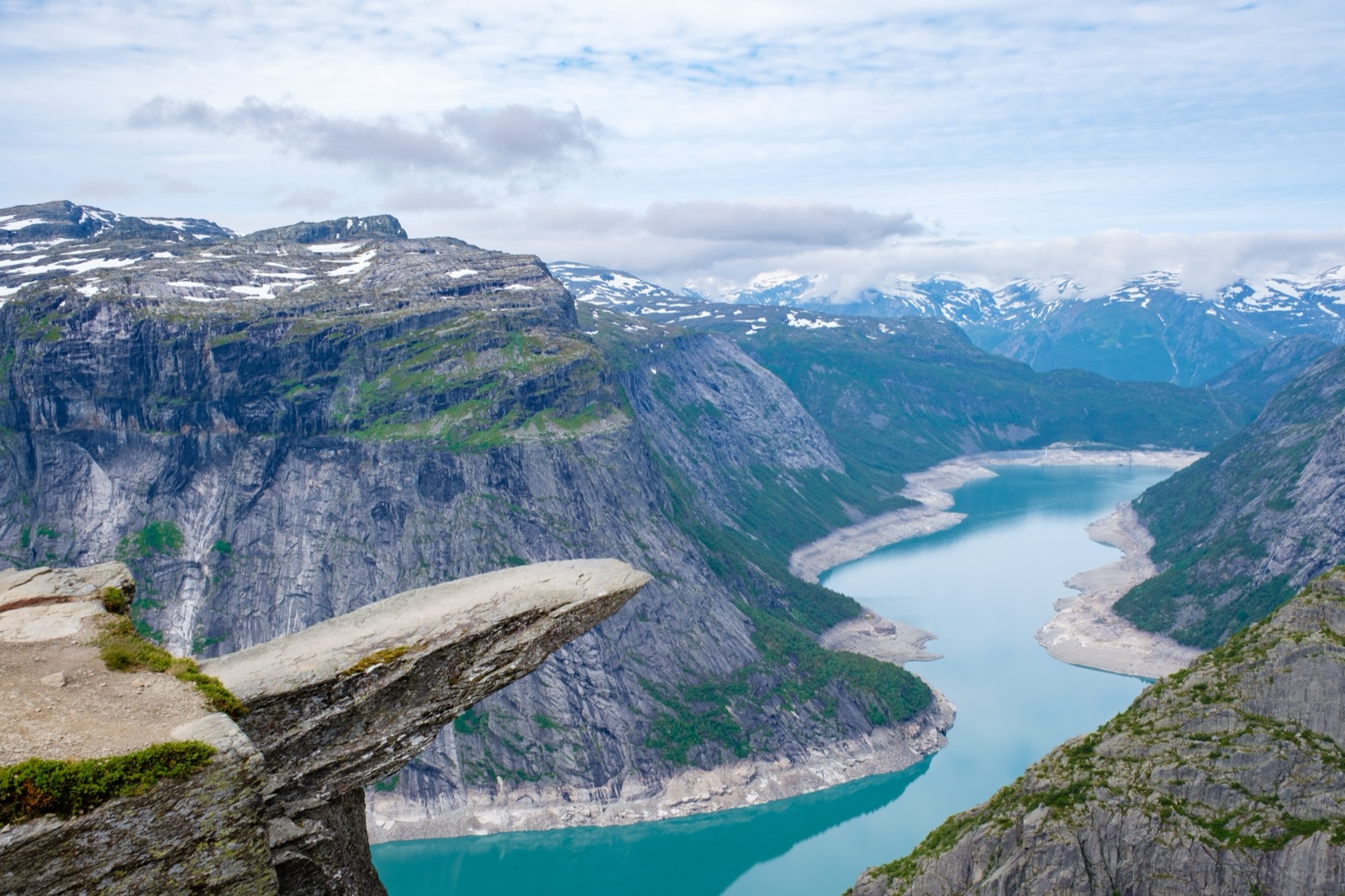
Camping at Trolltunga: Where You Can Pitch, the Rules, Gear and Guided Overnights
You can camp on the mountain at Trolltunga. Norway’s right to roam lets you pitch a tent on uncultivated land, and Trolltunga AS, the company owned by Ullensvang Municipality that runs the trail, accepts campers as long as they follow its rules: pitch at one of the sites marked with a tent symbol on its trail map, downhill from the trail and well away from streams and lakes, never near the car parks or the trailhead, and on bare rock where you can. Open fires are banned from 15 April to 15 September, there are no toilets on the mountain, and everything you carry up, used toilet paper included, comes back down.
The rules are the easy part; the night is harder. The plateau is exposed, it is always colder and windier than by the fjord, and Trolltunga AS warns that it can get cold at night. Below: where you may and may not pitch, water and waste, the cold, the emergency shelters, what to carry, parking for two days, and the guided overnights that save you the heavy pack.
The short answer
- Allowed: camping on the mountain, ideally at the sites marked with a tent symbol on the Trolltunga AS map, downhill from the trail and away from water.
- Not allowed: camping at or near the car parks and the trailhead, in signed no-camping areas, closer than 150 metres to an occupied house or cabin, or on cultivated land without the landowner’s permission.
- Fires: no open fires between 15 April and 15 September. Bring a stove.
- Toilets and rubbish: there are none on the mountain. Carry everything out, including used toilet paper.
- Water: fill up at P2 Skjeggedal, do not take stream water before the first emergency shelter near Floren, and boil it at camp.
- Shelters: for emergencies only, not for planned nights.
- Parking: at P2 Skjeggedal two days cost NOK 770 on the 2026 tariff; at P3 Mågelitopp, book two days if you leave the car overnight.
- No tent? Guided overnights include the sleeping gear and main meals.
The right to roam, and where it stops
Norway’s public right of access, allemannsretten, rests on the Outdoor Recreation Act, which came into force on 1 July 1957. Its camping section is short. On cultivated land you need the owner’s or user’s consent. On uncultivated land you may pitch a tent, but not so close to an inhabited house or cabin that you disturb the people in it, and never closer than 150 metres. You may stay up to two nights in one place without the owner’s consent (the Act says two døgn, or 24-hour periods); in the high mountains, or far from settlements, a longer stay needs no consent unless it causes noticeable damage or nuisance.
The Hardanger Code of Conduct, which Visit Hardangerfjord publishes for visitors to the region, adds the local reading. Its first point is to camp only in designated areas, and it spells out what the right to roam does not cover: built-up areas, rest areas, parks and parking lots are exempt.
Visit Norway adds the context: tent camping has put pressure on nature at the best-known spots, and several popular areas, particularly in Lofoten and parts of Fjord Norway, now have their own camping rules. At Trolltunga the right to roam is the starting point, and the trail operator’s rules sit on top of it. Its camping page mentions no permit or booking for a tent on the mountain; it asks you to camp where the damage is least and the water safest.
Where you may pitch on the trail
Trolltunga AS recommends pitching at one of the sites clearly labelled with a tent symbol on its trail map. The same map shows the nearest emergency shelter, the recommended camping spots and the places with running water, so download it before you set off. Its other conditions:
- Downhill from the trail, and well away from streams and lakes.
- On bare rock if possible, to reduce wear on the alpine vegetation. The operator calls this environment extremely vulnerable.
- A thick sleeping mat wherever you pitch. Trolltunga AS calls it an absolute must.
On the ground, the first likely stretch is past the second steep climb. After the Trombeskar pass the trail reaches a grassy valley that Trolltunga AS describes as popular with campers, then drops gently to Store Floren. Beyond that the trail crosses the plateau at about 900 metres, where the terrain is flatter but more exposed.
If you want to sleep close to the ledge for the evening light, note that the operator publishes no separate rule for the tongue itself beyond its map and its signs, so pitch only where the current map shows a tent symbol, and remember that there are no fences anywhere around Trolltunga. A tent near the edge in the dark is a bad idea in any wind.
Where you may not camp
Trolltunga AS asks campers to respect signs marking areas where camping is prohibited. These may be rest areas intended for all hikers, areas too close to private cabins, or areas with a particularly vulnerable environment. Beyond the signs, the fixed exclusions are:
- The car parks and the trailhead. No camping is allowed near the parking lots or the trailhead, and none at any of the car parks. The FAQ points you to the several campsites in Odda instead.
- P1 Tyssedal. Vehicles too long for the road to Skjeggedal park here, but overnight sleeping, camping, barbecues and open fires are not allowed.
In a campervan, sleep at a campsite and take the shuttle. Our article on where to stay near Trolltunga compares the campsites and hotels in Tyssedal, Odda and Lofthus.
Fires and stoves
Between 15 April and 15 September open fires are prohibited, Trolltunga AS says, and the Hardanger Code repeats the ban for the whole region. Outside those dates the code still asks you to use designated sites for campfires and make sure there is no risk of a forest or brush fire.
So bring food that does not need cooking, or a small camping stove, and allow fuel for boiling water as well as for meals: boiling is the operator’s suggested way to make stream water safe at camp.
Toilets and rubbish
There are no public toilets in the mountains. Use the toilets at the car parks in Skjeggedal or Tyssedal before you start, and on the mountain keep toilet visits well away from streams and lakes and downhill from the trail.
Everything you bring up goes back down: cans, bottles, all food packaging and used toilet paper, to the bins at the car park. The Hardanger Code allows a pit dug in the ground where no toilets are available, and asks you not to use wet wipes because they take a long time to decompose. Where the two sources differ, follow the trail operator, which asks for toilet paper to be carried out.
The code’s other points matter most to campers: avoid leaving any trace, such as cairns or tent pegs, and follow the path rather than creating new ones.
Water on the mountain
An overnight needs more water than a day hike, and the rules for finding it are specific:
- Fill up at P2. You can fill bottles in Skjeggedal, by the P2 car park.
- Wait until Floren. Do not fill from streams until you reach the first emergency shelter, just before Floren, about halfway to Trolltunga.
- Not near Trolltunga, not near cabins. Avoid filling water near Trolltunga itself, and note that the water near the cabin areas is not safe to drink.
- Running water, not lakes. A running stream is always better than a lake, and water can carry many impurities after heavy rainfall.
- Boil it. The water in the wilderness is not tested, and the operator cannot guarantee that it is safe. If you are camping, you can boil it.
Even Trolltunga Active’s guided dome trip asks you to carry 2 litres of water. In winter you cannot fill up on the mountain at all.
Cold, wind and the night
Trolltunga AS says it is always colder and more windy in the mountains than at the fjord, and that it can get cold at night. Trolltunga Active adds that temperature can be deceiving, because the wind plays an important role in how cold it feels, and in early summer you can climb from valley warmth to big patches of snow. The camping advice follows:
- The tent. Choose a lightweight, durable tent designed for mountain conditions. Strong winds can easily tear apart cheap tents.
- The bed. Bring a warm, high-quality sleeping bag and a good pad, because a lot of body heat is lost through the ground.
- The clothes. Trolltunga AS recommends wool all year round, because wool keeps you warm when it is wet; Trolltunga Active warns that cotton is freezing cold once it is wet. Pack warm clothes for sitting still in the evening, not just for walking.
- The forecast. Never hike to Trolltunga in strong wind, heavy rain or fog, and on an overnight check the forecast for both days.
The season sets the outer limits. Even towards the end of June there may still be snow on the plateau in some years, and from mid-October snow can settle again. Our article on Trolltunga weather and the best time to go has the month-by-month figures.
Emergency shelters and the mountain rangers
There are three emergency shelters on the trail, at Floren, Endåen and Tyssehøl. They hold sleeping bags, blankets and emergency supplies, and they are there if you are in distress or caught by sudden bad weather. Two were built in 2016, after 42 rescue operations that year, and the third opened near Trolltunga itself in 2023.
They are not a place to plan a night. Visit Norway says the rescue cabins are for emergencies only and not intended for overnight stays (it counts two; Trolltunga AS, which runs the trail, lists three). Plan around your own tent.
The Mountain Ranger cabin is staffed around the clock from about 17 May to mid-October, and Visit Norway notes that in summer a mountain guard is present at Trolltunga day and night. There is mobile coverage along most of the trail. If you are hurt or in a serious emergency, call 112.
What to carry for a night out
Camping in the mountains means carrying a much heavier backpack. Visit Norway suggests a 30-litre pack for the day hike; Trolltunga Active asks for at least 40 litres on its guided overnight, where the tent, dinner and sleeping bag are already on the mountain.
- Shelter and sleep: a mountain tent, a warm sleeping bag and a thick mat.
- Kitchen: a small stove, fuel, a pot, and food for dinner and breakfast as well as the hike. The operator advises eating about every two hours on the trail.
- Water: bottles for the walk, plus enough fuel to boil water at camp.
- Clothing: a wool base layer, a warm mid layer, waterproof and windproof outerwear, an extra set of clothes, a hat and gloves.
- Safety: a map and compass, a first-aid kit, a fully charged phone and a headlamp.
- Boots: hiking boots, not trainers. You cross wet marsh, mud and water in several places.
If your kit is not up to it, Trolltunga AS points to three sources: professional equipment to rent from Trolltunga Active in Skjeggedal, several sports shops in Odda, and well-used equipment on Finn.no.
Parking and shuttles for a two-day trip
Camping turns a one-day parking ticket into a two-day one. On the 2026 tariff:
| Car park | Same day | Two days | Three days |
|---|---|---|---|
| P2 Skjeggedal (road toll included) | NOK 550 | NOK 770 | NOK 990 |
| P1 Tyssedal | NOK 330 | NOK 550 | NOK 770 |
| P3 Mågelitopp | NOK 600, plus NOK 220 road toll | book two days | not listed |
P1 is cheaper but adds the valley to your walk: the return hike from there is 38 km.
P3 for overnights. If you want to leave the car at P3 overnight, book two days. Until 31 August P3 is pre-booked only, and from 8 June to 31 August cars may enter the P3 road from P2 only between 6:30 am and 11 am. That suits an early start, not an afternoon one.
The afternoon shuttle. If you want to walk in late and see the evening at the ledge, the shuttle bus is the better tool. Afternoon buses from P2 up to P3 run from 14:45 to 18:45, drop-in only, and the shuttle’s own page says an afternoon departure is not recommended unless you plan to stay overnight near Trolltunga. Next day, morning buses run down from P3 between 06:45 and 11:15, and afternoon buses from 14:30 until the last at 19:00.
The road below. In autumn 2026 the road from P1 Tyssedal to P2 Skjeggedal was closed from 21:00 to 06:00 for rockslide protection work, so check the trolltunga.com front page before a late arrival or early departure. Our guide to getting to Trolltunga covers the fees, shuttles and timetables in full.
Guided overnights and glamping
Trolltunga AS puts the choice plainly: set up camp on your own and you carry all your gear; choose a guided tour with an overnight stay and almost everything you need is included.
- Trolltunga Active, Sunset-Sunrise Summer. 28 hours from NOK 4,400, with the shuttle to P3 and a dome camp about 3 km before Trolltunga; a separate tent can be added at booking. A warm sleeping bag and liner, hiking poles, dinner and breakfast are included, and by the time the group reaches the ledge most hikers are heading down. Minimum age 13.
- Trolltunga Adventures, guided overnight tour. Starts at 11:15 in Skjeggedal, reaches Trolltunga at around 5 pm, and sleeps in a camp near Trolltunga at 1200 metres, with all necessary equipment and the main meals provided. You are back in Skjeggedal between 2 pm and 3 pm next day. The group is limited to 12, and the tourism board lists it from NOK 4,300. The operator also offers a private camp for your own group with your own guide.
- Sunset-sunrise without a guide. Trolltunga AS lists a sunset-sunrise option for experienced hikers who want to spend the night near Trolltunga on their own, without carrying all the camping gear. Check the operator’s site for this season’s terms.
- Via ferrata plus a night. The via ferrata can be combined with a night on the mountain.
One trip on the tours page covers the night out. The sunset glamping trip (25 hours) uses the shuttle bus to shorten the hike, serves dinner with a view, and sleeps in a dome tent with a see-through ceiling away from the main trail. Our guide to the via ferrata and guided tours compares the guided formats in more detail.
One caution for every overnight: the sun rises behind the mountain, so you cannot photograph Trolltunga with the sunrise itself. The evening is the reason to stay.
When to camp
From 1 June to 30 September experienced hikers can go on their own, and the fire ban covers most of it. In 2026 the shuttle from P2 to P3 ran from 8 June to 27 September, and the ranger cabin is staffed from about 17 May to mid-October.
- June: long days, with daylight of almost 19 hours in summer, but possible snow on the plateau.
- July and August: the warmest months and the busiest. The ledge is most crowded between 12:00 and 15:00 from about 20 June to 20 August, and there is little or no queue early in the morning or later in the afternoon, which is exactly when campers are there.
- September: autumn colours and sunsets towards Folgefonna, but cooler, wetter weather and shorter days.
- October to May: guided trips only. Trolltunga Active’s Sunset-Sunrise Winter trip, 28 hours from NOK 4,650 with a night in the mountain domes, is the winter version, with a minimum age of 15.
Dogs must be kept on a leash between 1 April and 31 October in Ullensvang, and drones are strongly discouraged. Our Trolltunga hike guide covers the trail itself, section by section.
Frequently asked questions
Is wild camping allowed at Trolltunga?
Yes. The right to roam lets you pitch on uncultivated land, and Trolltunga AS allows camping on the mountain at the sites marked with a tent symbol on its map, downhill from the trail and away from streams and lakes. Camping is not allowed near the car parks or the trailhead.
Do I need a permit to camp at Trolltunga?
Trolltunga AS’s camping rules mention no permit or booking for a tent on the mountain. What you pay for is parking: two days at P2 Skjeggedal cost NOK 770 on the 2026 tariff.
Can I sleep in the emergency shelters?
Only in an emergency. The shelters at Floren, Endåen and Tyssehøl are for hikers in distress or caught by sudden bad weather, and Visit Norway says they are not intended for overnight stays.
Can I have a campfire at Trolltunga?
Not between 15 April and 15 September, when open fires are prohibited. Bring food that needs no cooking or a small camping stove.
Can I camp at the Trolltunga car parks?
No. Camping is not permitted at any of the car parks, and at P1 Tyssedal overnight sleeping is not allowed either. The destination company points to the several campsites in Odda.