Is Trolltunga Dangerous? Accidents, Rescues and How to Stay Safe
Trolltunga is not especially dangerous for a fit, well-equipped hiker who walks in summer and turns back in bad weather, but it is a serious mountain day, and the danger is mostly not where people expect. There is no railing at the edge, and in 2015 a young Australian woman died after falling from the ledge, believed to be the first recorded death from a fall there. Yet the great majority of rescues have nothing to do with the cliff. They happen on the long trail: hikers who underestimate a 20–27 km round trip, run out of energy, get lost in fog, twist an ankle, or are caught by cold on the way down.
The numbers have improved a great deal. In 2016 there were 42 rescue operations. After two emergency shelters were built that year and Mountain Rangers were put on the trail in 2017, the count fell to 21 in 2017 and to 12 in the summer of 2018, as NRK reported. This guide explains where the real risks lie, what has changed on the trail, and the handful of decisions that keep you out of the statistics.
The short answer
- The ledge: no railing, a drop of around 700 metres to the lake, and one recorded fatal fall. Stay back from the edge and the risk is small.
- The hike: the real hazard. It is graded Very Demanding, the top of the Norwegian scale, because it is over 20 km long.
- The weather: the decider. Trolltunga AS says never to hike in strong wind, heavy rain or fog.
- The season: from June 1st to September 30th experienced hikers can go alone; for the rest of the year, go with a guide.
- Help: Mountain Rangers in summer, three emergency shelters, and 112. Emergency services in Norway cost nothing.
What the record shows
Trolltunga went from a local walk to a world-famous one very quickly. Trolltunga AS counts 800 visitors in 2010 and 87,000 in 2018, and today puts the figure at around 80,000 a year. In 2024, 86 percent of visitors were foreign travellers, many on their first long Norwegian mountain hike. One day in July 2017 a record 1,839 people passed Gryteskaret on the way to the ledge, according to an NTB news agency report carried by Haugesunds Avis.
That growth brought rescues. Trolltunga AS writes that many tourists used to be poorly prepared: some were inadequately dressed, carried too little food and water, and became completely exhausted.
| Year | Rescue operations | Source |
|---|---|---|
| 2016 | 42 | Trolltunga AS, NRK |
| 2017 | 21 | NRK |
| 2018 (summer) | 12, seven of them by helicopter | NRK |
Since then Trolltunga AS says the number of rescue operations has dropped drastically. The most common injury is a sprained ankle.
The ledge: what the danger actually is
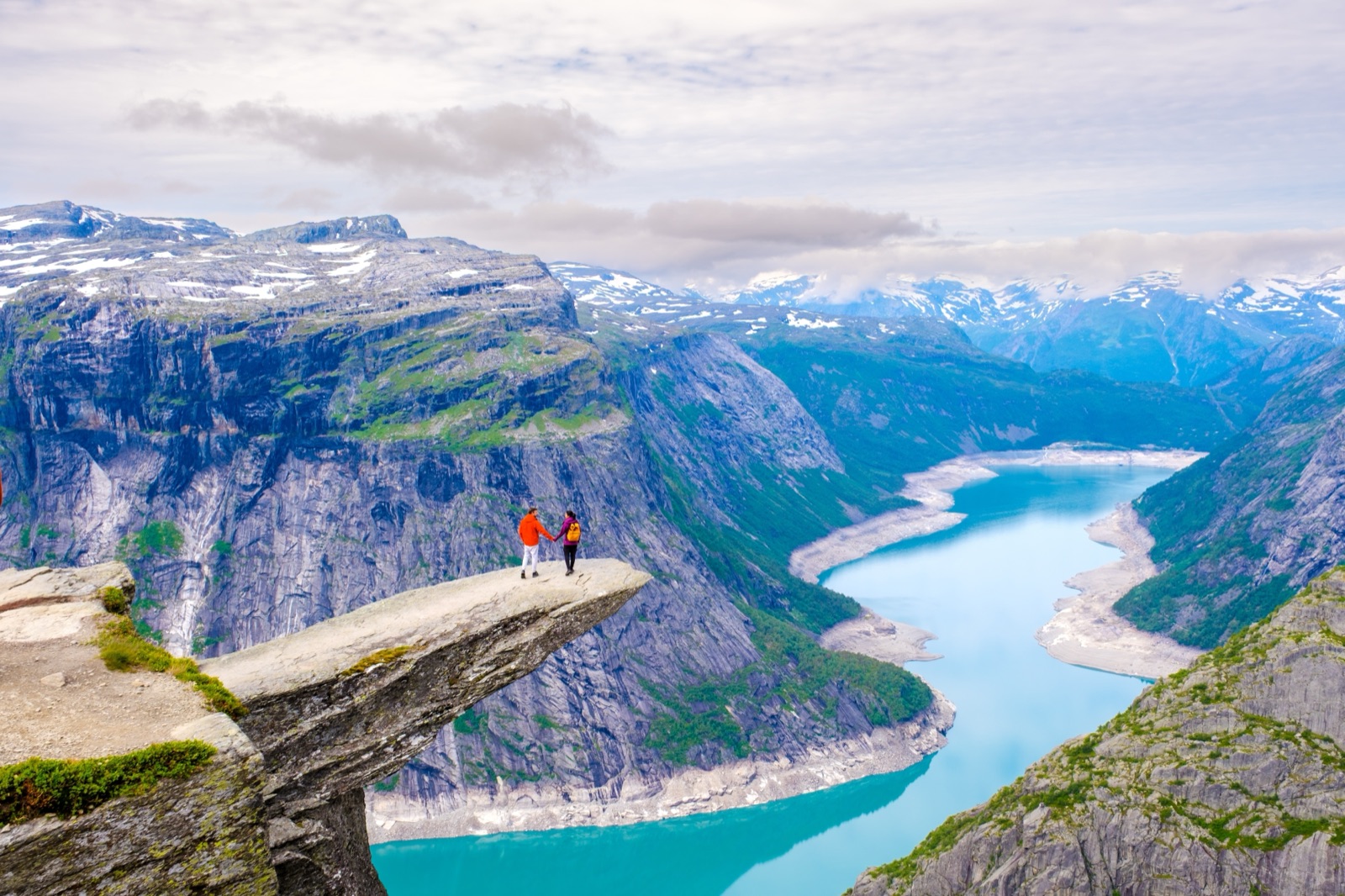
The tongue of rock sticks out about 700 metres above Ringedalsvatnet. There is no railing: a deliberate choice, so as not to harm the natural beauty of the cliff. Four iron rebar steps make it easy to climb down onto the tongue itself, and the rock is broad enough to stand on comfortably.
The one recorded fatal fall happened on 5 September 2015, when a 24-year-old Australian exchange student fell while posing for a photograph. The BBC noted at the time that the cliff, visited by thousands of tourists every year, has no safety rail, and that thrill-seekers had been posing at the very edge, some jumping in the air. Many of the viral photos of people hanging off the tip or doing handstands on it are, as Wikipedia notes, most often manipulated.
The rules here are simple, and Trolltunga AS states them bluntly: always stay at least a couple of feet back from the edge of the cliff, because a fall would be fatal. Near the end the trail narrows, and you should be very mindful of the high drop. In rain, the wet rock can be slippery. If you are afraid of heights you do not need to go onto the tongue at all: a photo taken from the side, with the ledge in the background, is just as good. The Trolltunga photo guide covers how to get it.
The trail: where most rescues happen
Wikipedia’s summary of the rescues is the clearest: there have been up to 40 rescue actions in some years, mostly not because of the dangerous cliff but because of the demanding hike back. People get lost in fog, get injured on the way, or do not have the endurance for such a long day.
The Trolltunga trail is well maintained, solid and clearly marked. What makes it hard is the length and the shape of the day:
- Two steep climbs early on. The climb to the Gryteskaret pass is considered one of the most strenuous stretches of the hike, and Trombeskar follows.
- A long exposed plateau. Once on it, at about 900 metres, the major climbs are behind you, but the terrain still has many ups and downs and no shelter from wind.
- Rivers and late snow. Use the bridges to cross Endåen and the other riverbeds, whether or not they look dry. Snow can lie into late June.
- The return. Your return takes less time, but it comes at the end of a long day. Many accidents happen on the way down, when hikers are tired.
The manager of Trolltunga AS told NRK in 2018 that most rescues are of tourists who simply run out of energy. A ranger quoted by Haugesunds Avis put it the same way: most of the people they help have underestimated the hike and are totally exhausted. The Trolltunga hike guide gives the route section by section, with times.
Weather: the risk you can see coming
Trolltunga AS repeats one rule on every page: never hike to Trolltunga if there is a strong wind, heavy rain or fog, and remember that it is always colder in the mountains than down by the fjord. It adds that every year there are rescues of tourists who were poorly equipped or not well enough prepared.
- Fog is the classic cause of people getting lost on the open plateau, where there are few landmarks to steer by.
- Wind makes a mild day cold and the exposed ledge unpleasant. Trolltunga Active notes that temperature can deceive, because the wind plays an important role in how cold it feels.
- Rain makes rock slippery and soaks anyone in cotton.
- Sun is a risk too: even if the wind is cool you can get sunburned without noticing until it is too late.
Check the forecast the evening before and the morning of the hike, and follow the Trolltunga Trail Information page on Facebook for conditions on the trail. If the forecast is bad, move the day; if the weather turns on the way, turn back. The weather guide covers the months in detail.
The season: why outside summer is different
Trolltunga AS draws a clear line. From June 1st to September 30th, experienced hikers can hike on their own. For the rest of the year it recommends a guided hike, and in winter only guided tours. Snow can settle as early as mid-October, snow showers may come earlier, and in spring the path is often covered with snow until May or June.
NRK’s report from early October 2018 shows why. Snow had already covered the mountain, and one hiker, cold and cramping after ten kilometres, had to be flown down by helicopter. The Mountain Ranger cabin is staffed around the clock only from about 17 May to mid-October, so outside those dates there is no ranger on the mountain to help. Daylight shrinks too: from almost 19 hours in summer to less than 6 hours in winter. If you are coming in autumn, winter or spring, read Trolltunga in winter and go with a guide.
What has made the trail safer
The drop in rescues is not luck. After 42 rescue operations in 2016, Trolltunga AS and the municipality changed several things:
- Emergency shelters. Two were built in 2016 and a new one opened near Trolltunga itself in 2023. The three shelters, at Floren, Endåen and Tyssehøl, hold sleeping bags, blankets and emergency supplies, and are for anyone in distress or caught by sudden bad weather.
- Mountain Rangers. The patrol system was introduced in 2017. The ranger cabin is staffed around the clock in season, and a ranger walks to the ledge around midday to organise the photo queue unless needed for a rescue.
- Checks at the start. Parking attendants and rangers make sure hikers are properly dressed and carry enough food and water.
- Better trail and information. Improved mobile coverage, upgraded trails, better pre-hike information, and signs and information boards along the route. NRK reported that clearing stumbling sections in 2018 saved hikers about 45 minutes.
Part of this is paid for by you: the road toll to P2 funds trails, signs, information boards, the rescue shelters and the Mountain Rangers.
What the rangers can and cannot do
The rangers advise; they do not decide for you. Wikipedia notes that they give advice and information but cannot actually prevent anyone from starting the hike. A ranger told Haugesunds Avis that they tell people every day to turn back, and that many ignore it. Some hikers, he said, even hide when they realise the rangers are looking for them, out of embarrassment, or because they fear help will cost money.
It will not. Emergency services in Norway cost nothing. If a ranger tells you that you are too late, too slow or too badly dressed to reach the ledge and get back in daylight, take the advice: it comes from people who carry the exhausted down.
Fitness: are you ready for it?
Trolltunga AS is direct about who should not go. The walk up is long and arduous, and if you have heart problems or other medical conditions you should not take the trip. If you are not used to long days in the mountains, it suggests choosing other attractions, or training first with shorter trips.
A realistic test: can you walk 20 km with around 800 metres of climbing, carrying a day pack, and still feel steady on your feet at the end? If not, consider the 20 km route from P3 Mågelitopp rather than 27 km from P2, a guided hike that sets a sensible pace, or a shorter walk near Odda instead. The Odda guide has several.
Children
Trolltunga AS recommends that everyone on the trip is at least 12 years old, in good physical shape and used to long walks. The mountain is not a safe place for infants and toddlers, who are especially vulnerable to cold and bad weather. If you bring young children against that advice, Trolltunga AS says you must be prepared to carry them all the way, stopping often to check that they are warm. Trolltunga Active’s guided summer hike has a minimum age of 13, and its winter tours 15.
The decisions that keep you safe
The Norwegian Mountain Code, published by the Norwegian Trekking Association, sums up most of what matters. Applied to Trolltunga:
- Check the forecast and do not start in strong wind, heavy rain or fog.
- Start early. Leave time for the queue, breaks and a slower descent, and aim to be back at the car well before dark.
- Set a turnaround time and keep it. The Code’s line is worth remembering: turn around in time; there is no shame in turning around.
- Eat about every two hours and drink before you are thirsty. You are more prone to accidents when tired.
- Stay on the trail and keep your group together. It is much easier for rangers to find a group than individuals scattered across the mountain. Match the pace of the slowest member.
- Tell someone your plan and when you expect to return.
- Carry the right kit: layers, rain gear, food, water, headlamp, first aid kit. The packing list has the details.
If something goes wrong
- Call 112. Give an accurate description of your situation and where you are, and make yourself clearly visible. Norway’s numbers are 112 for police, 113 for medical emergencies and 110 for fire.
- Use a shelter. If the weather turns or someone is struggling, head for the nearest emergency shelter at Floren, Endåen or Tyssehøl. The trail map shows where they are.
- Find a ranger. In season, the ranger cabin is staffed around the clock.
- Stay together. Do not send an exhausted hiker on alone, and do not split the group in fog.
Is a guided hike safer?
For most people in summer, a guide is a comfort rather than a necessity. Outside summer it is the recommended way to go. A guide sets the pace, knows the weather signs, carries safety and first aid equipment, and checks your kit before you start. Trolltunga AS strongly recommends a guide for people with limited mountain experience. Trolltunga Active’s winter hike runs from NOK 1,550 per person, and the guided options are compared in the guided tours guide and on the tours page.
Frequently asked questions
How many people have died at Trolltunga?
One recorded fatal fall from the ledge is known: a 24-year-old Australian exchange student in September 2015, believed to be the first recorded death from a fall there. Most incidents since have been injuries and exhaustion on the trail, not falls from the cliff.
Is there a railing at Trolltunga?
No. No safety railing has been built, to avoid harming the cliff’s natural beauty. Four iron rebar steps help you climb down onto the tongue. Stay at least a couple of feet back from the edge.
How many rescues are there at Trolltunga?
There were 42 rescue operations in 2016, 21 in 2017 and 12 in the summer of 2018, according to Trolltunga AS and NRK. Trolltunga AS says the number has dropped drastically since the Mountain Rangers started.
Is Trolltunga safe for beginners?
A fit beginner can manage it in summer in good weather, but it is graded Very Demanding and takes 7–10 hours even from P3. Trolltunga AS recommends a guide for people with limited mountain experience.
Does a rescue at Trolltunga cost money?
No. Emergency services in Norway cost nothing. Call 112 if you are hurt or in a serious emergency.